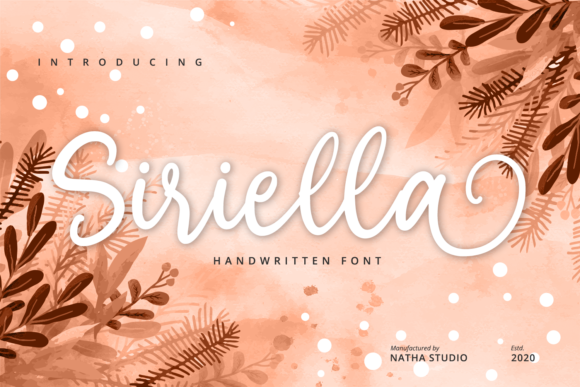
Siriella: A Handwritten Script Font for Modern Editorial Design
Choosing the Right Font for a Lifestyle Blog Redesign
While working on a recent lifestyle blog refresh, I found myself sifting through dozens of script fonts, trying to find one that felt both elegant and readable. That’s when I came across Siriella—a soft, handwritten script font that immediately caught my eye. Unlike many overly ornate scripts, Siriella has a grounded, approachable rhythm that made it feel like a natural fit for editorial headers and content accents.
Visual Character and Editorial Appeal
Siriella carries a gentle, personal tone. It’s not overly dramatic or stylized, which helps it maintain a sense of professionalism while still feeling warm and human. The font’s natural flow and subtle variations in stroke weight give it a hand-drawn quality that works especially well for content with a personal or creative edge—think recipe ebooks, wedding guides, or coaching workbooks.
What sets Siriella apart from other script fonts is its balance. It’s expressive enough to stand out in a layout, yet restrained enough to maintain clarity. The letters connect smoothly without becoming tangled, and the spacing feels intuitive, especially when used at larger sizes for headlines or pull quotes.
Real-World Use: Newsletter Headers and Chapter Openers
I tested Siriella in a few different contexts. One of the first was a weekly creator newsletter. I used it for the header graphic and a featured pull quote. On screen, the font held up well—its curves and openness made it easy to read even in a small banner layout. I also used it in a printable planner template, where it served as a soft accent font for section headers and decorative elements.
In a longer-form project—a digital magazine layout—I used Siriella for chapter openers and sidebar highlights. It brought a sense of visual rhythm to the layout without overwhelming the more structured body text. When paired with a clean serif font like Georgia or a modern sans serif like Lato, Siriella added just the right amount of warmth and personality.
Readability and Format Considerations
It’s important to note that Siriella is best suited for short bursts of text rather than long-form body copy. Its script nature makes it less ideal for dense paragraphs or small captions, especially in print or mobile formats where clarity is key. However, at sizes above 18pt, it reads beautifully on both screen and print, making it a strong choice for titles, headlines, and featured text elements.
In a PDF export for a coaching workbook, I found that Siriella retained its charm and legibility when converted to PDF, and the PUA encoding allowed for easy access to alternate characters, which added a nice touch of customization without complicating the workflow.
Font Pairing and Editorial Consistency
One of the most valuable aspects of using Siriella in an editorial layout was how well it paired with other fonts. As a display font, it shines when used alongside more neutral, readable typefaces. For example, pairing it with a serif font like Merriweather for subheadings or a clean sans serif like Open Sans for captions created a balanced visual hierarchy.
This kind of font pairing is essential for maintaining both mood and readability in editorial design. Siriella brings the personality, while supporting fonts handle the structure. It’s a dynamic that works especially well in digital magazines, newsletters, and branded content guides where tone and clarity must coexist.
Practical Considerations for Content Creators
Before committing to Siriella for a client project, I made sure to check the full character set, ligatures, and multilingual support. The font includes a wide range of alternates and stylistic sets, which can be useful for crafting unique headlines or branded headers. It also supports common file formats like OTF and TTF, making it compatible with most design tools.
For commercial use—especially in templates, ebooks, or digital downloads—it’s important to verify the licensing terms. Siriella is typically available with a commercial license, which makes it a safe and flexible choice for bloggers, newsletter writers, and independent creators who want to maintain brand consistency across their materials.